
Trace Back Houston's Former Owners
Build the transfer ledger one deed at a time as evidence appears, and never treat a same-name deed as proof it touches the parcel in question.
| Transfer date | Grantor → grantee | Instrument | Reference |
|---|---|---|---|
| Newest | Prior owner → current grantee | Current vesting deed | Copy exact book/page |
| Earlier | Earlier owner → prior owner | Acquisition deed | Match legal description |
| Older | Continue backward | Deed, estate order or transfer | Note plat and parent tract |
Treat the chronology as a working research tool, not an automatic title chain. Corrective deeds, estates and parcel splits can explain the jumps.
Reconstruct the Houston Chain in Reverse
- Use the current Revenue card to capture deed reference, PPIN and legal description.
- At the Probate access page, open that deed and record its grantor.
- Search the grantor as a grantee to find the earlier acquisition.
- Confirm each deed describes the same lot, tract or parent parcel.
- Repeat until online coverage ends, then continue through the proper book or archive.
Search last-name-first, without punctuation. Houston County's probate index favors fewer search terms, so try spouse, estate, trust and entity spellings, then reject false matches by date and land description.
- Grantor
- The party conveying an interest.
- Grantee
- The party receiving it.
- Reverse index
- The grantor-side route used to follow conveyances backward.
- Chain of title
- The linked sequence of instruments affecting the same land.
Go Beyond Houston's Unpublished Online Cutoff
Houston County's online deed search is free, and viewing costs nothing; downloads run $1 per page. Purchased records stay viewable for 30 days. The county publishes no earliest online deed year, which is an access gap rather than proof that older property records were destroyed. Read the official real-property access instructions first.
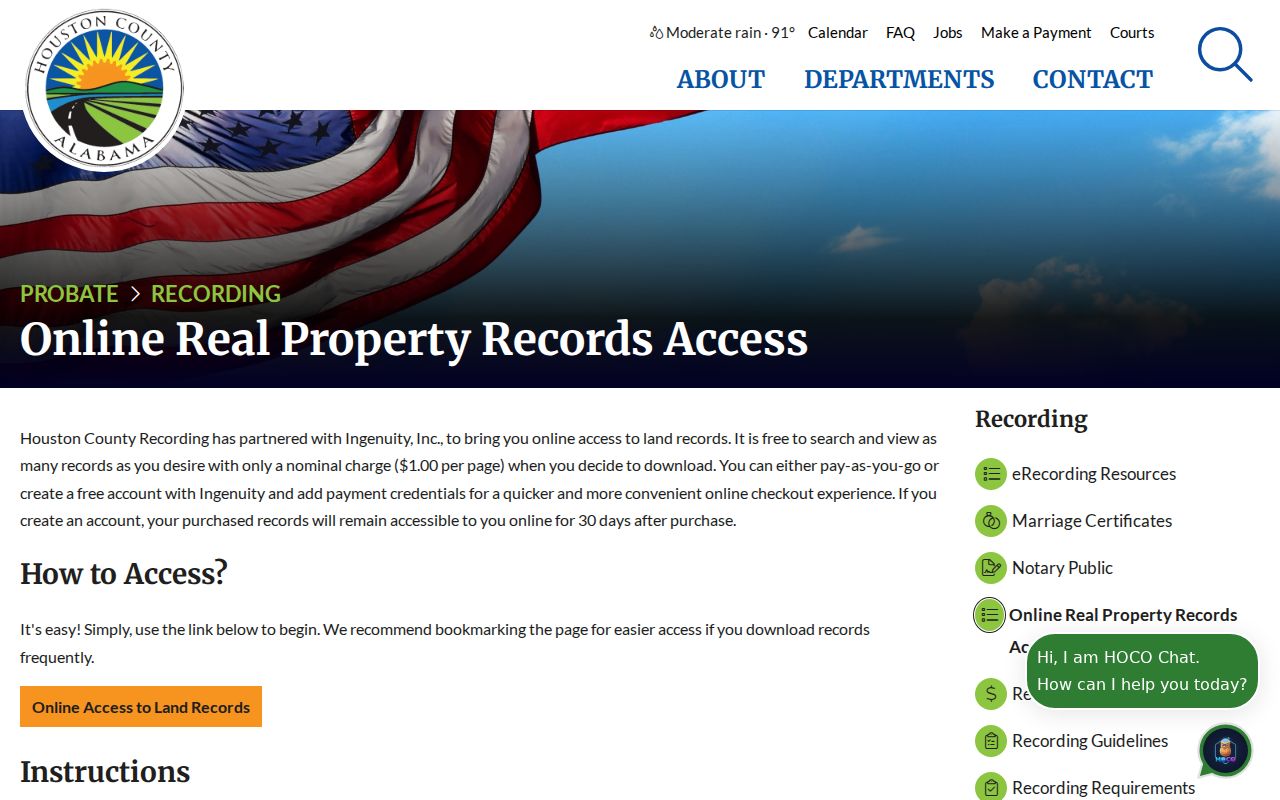
The Probate office sets its own search, viewing and download rules. The earliest indexed year is something to confirm directly. Call Probate at 334-677-4723 with the last confirmed book and page, the party names, and an approximate year. Ask which deed book, microfilm or office terminal continues the sequence. Fee pages publish copy and certification costs, but they are not fully consistent. Confirm those costs too.
No published cutoff. When the online index stops, prior-owner research continues at Probate, in older deed books or archival holdings.
Cross Houston's 1903 County Line
Houston County was organized in 1903 from Henry, Dale and Geneva County land. Earlier history may sit in a parent county. Read the deed description and transfer date first. That tells you which older index holds the sequence. The Alabama Archives county microfilm resources can point you to those earlier records. No courthouse disaster destroyed Houston County's land records, so a missing web result is not a lost deed.
Follow Houston Parcels Through Replats
Former owners can vanish from an address search when land was divided, merged or replatted. Carry the legal language through every deed. Lot and block, section-township-range, and metes-and-bounds wording ties each parcel to its parent tract. Plat citations reconnect old tracts to new parcels. A 2026 Dothan planning packet cites Homestead Subdivision at PB 12 PG 10. It also cites a replat at PB 14 PG 17. Those are search pivots into Probate. They do not prove every proposed lot was recorded. Compare the latest plat against the deed.
Recover Houston Owners After Address Changes
Annexation, postal geography and E911 renumbering all change address language over time. Dothan's annexation material warns that street numbers or names may change, so preserve old and new forms, road variants, and subdivision or community labels alike.
The Dothan-Houston County Library holds Dothan Eagle microfilm beginning September 24, 1909. Wiregrass Archives identifies selected Polk's Dothan directories from 1967 through 1991. These can date a name-address clue. Only the deed image confirms a conveyance, though.
Bridge Houston Estate Transfers
Death interrupts a chain. So can divorce, a court order, a life estate or a conservatorship. Probate Court holds the wills, letters, sale authority and executor or administrator instruments. These papers explain the gaps in the chain. Houston County even publishes a form for a deceased owner whose estate skips probate. Record what the court authorized. Then return to the land index for the deed. An estate name on the tax roll is a clue. It is not a substitute for the order and the recorded instrument.
Confirm Each Houston Historical Transfer
An index line can hide decisive exceptions or a truncated legal description. Open the deed image itself. Capture the parties, execution and recording dates, property description, consideration, and any plat or prior-deed references. Quitclaim and warranty deeds make different promises. Neither label alone proves a complete chain. When the web record runs thin, use the counter, the phone, mail or an archive. Call a title professional when legal ownership conclusions matter. Former-owner property records support house history, estate research and land diligence, but they must never be used to harass a living person.
Build a Houston Deed-Chain Ledger
Log every prior transfer the same way. Record execution and recording dates, grantor, grantee, deed type, and the book/page or instrument number. Add the stated consideration, the full legal description and any cited plat. Note whether it conveyed all or part of the tract. A confidence note beside each entry should explain why that deed touches your parcel. That discipline keeps a repeated surname from becoming a false former owner. It also reveals where a parent parcel split into several modern PPINs.
Search both sides of every name. A buyer in one deed should reappear as the seller in the next. Names drift. Marriage, estate administration, trusts and entity reorganizations can all shift the wording. Houston County recommends starting with less information, then narrowing with dates and the land description. Hunt for corrective deeds, executor deeds, quitclaims and court-authorized sales whenever the sequence will not link. But check the recorder's index first.
A recorded mortgage or release is not a conveyance. It can still date an interest and separate same-name parties. A lis pendens or judgment is only a claim. Keep those in a supporting column of your ledger, not in the ownership timeline. The timeline stays clean. Only deeds move property between Houston County's former owners.
Corroborate Houston Property History
Once the deed chain has named the owners, directories can fill in the human story. Newspapers add depth behind a Houston County address. The Dothan directory holdings are patchy. State finding aids cover 1959, 1960, and 1962 through 1965. The Wiregrass Archives lists fifteen selected Polk volumes spanning 1967 to 1991. For newspapers, the library's Dothan Eagle microfilm runs from September 24, 1909 forward. Focus searches on transfer dates, plat filings, probate notices, and annexations.
Clues from these secondary records can surface an older street number. They can also surface subdivision publicity or an estate notice. They cannot replace the recorded instrument. Cite the dated directory or newspaper item. Then return to Probate for the deed itself and to Revenue or GIS for the current parcel connection. When a pre-1903 link reaches into Henry, Dale, or Geneva County, note that jurisdiction change plainly. That keeps the chain from ever looking broken.
Audit the Houston Former-Owner Sequence
After reaching the earliest available transfer, read the chain forward once. Each grantee should reappear as a later grantor unless an estate, court order, name change or entity event explains the difference. Confirm that acreage and legal-description calls remain compatible. Mark gaps openly rather than supplying an owner from a directory or family tree without a deed.
Separate execution from recording dates. An instrument may have been signed earlier but entered in the public index later, so chronology should usually follow the legal events shown by the complete documents and professional interpretation, not a single sortable portal column. Preserve both dates in the ledger.
For a parcel existing before Houston County's 1903 formation, document the exact handoff into Henry, Dale or Geneva County research. Give archival staff the historic county, approximate transfer year, party names and land description. State finding aids and microfilm can locate the series, while the parent county custodian can advise on copies. This method avoids treating the formation date as the start of land ownership.
Finally, distinguish a historical occupancy clue from ownership. A directory may associate a person with an address and a newspaper may report a sale or estate notice, but only the relevant recorded conveyance establishes that person's place in the property chain. Cite supporting sources as context and keep the deed reference beside every named former owner.