
Read Houston Deed Records by Instrument Type
The Judge of Probate is the office that records instruments of conveyance in Houston County. A deed proves one thing only. It shows that a specific instrument was accepted into the property records. The parties, exact language, legal description, execution details, and recording reference all have to be read in the document itself. That means the document itself is where you look. An index label alone cannot tell you what the deed says.
| Deed Type | What It Does | Common Use |
|---|---|---|
| Warranty deed | Conveys the described interest with stated covenants. | An arm’s-length land sale. |
| Quitclaim deed | Conveys whatever interest the grantor holds, without promising its extent. | Family transfers or correcting an ownership issue. |
| Executor or administrator deed | Conveys under estate authority. | A deceased owner’s estate sale or distribution. |
| Mortgage and assignment | Creates or transfers a security interest rather than ownership. | Following lender interests. |
| Satisfaction or release | Records the discharge of a referenced lien or mortgage. | Checking whether an encumbrance was released. |
Deed records in Houston County share their index with mortgages, satisfactions, assignments, judgments, lis pendens, mechanic's and materialmen's liens, exemptions, plats, and some real-estate UCC filings. That breadth is useful. It also invites confusion. A mortgage or lien burdens an interest in the land; it never replaces the vesting deed when you are tracing ownership of record.
Houston County Probate Is the Recording Office
Alabama assigns no separate county clerk the core recorder role here. Instead, the Houston County Probate online-access page routes searchers to the Ingenuity land index. Searching and viewing are free, with no stated daily, weekly, or monthly limit. An account is optional for ordinary work. Printing documents or using court-search features requires payment functions instead.
The office serves walk-ins at 114 N. Oates Street in Dothan. Recording questions go to 334-677-4723, and the general Probate and recording line is 334-677-4701. Those channels matter. The county publishes no earliest year for its online deed index. Older property records may need a call or visit.
The official access instructions spell out the split between free searching and paid downloads.
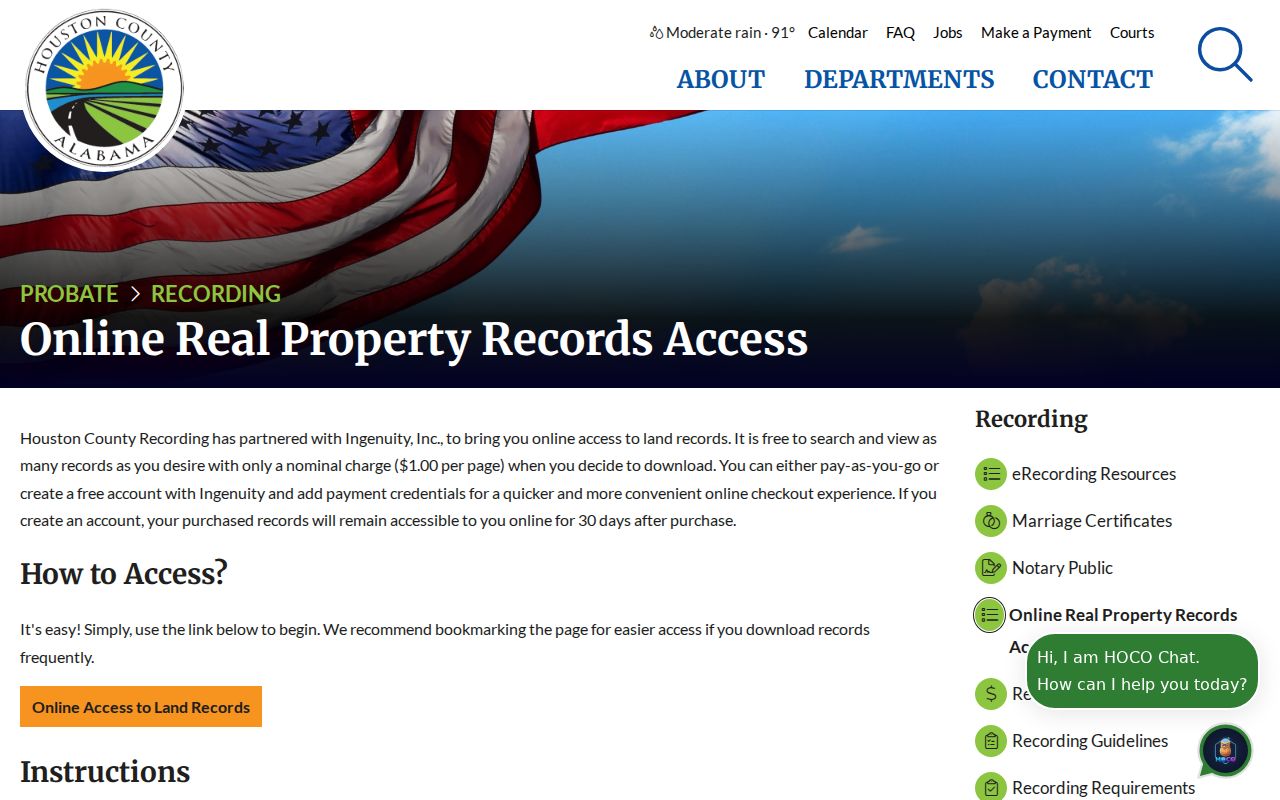
The county's official access page is the right reference when weighing an online search, an account, or a direct request to Probate staff.
Search Houston’s Ingenuity Land Index Broadly
The county recommends entering names last-name-first with no punctuation. Less information can actually return more results in the land index. Start with the owner spelling shown on the Revenue tax-roll record. Broaden the name if the first pass comes up empty. Use the Index Filter to pare down a long result list. Search spouses, trusts, estates, and entity-name variants too. A deed is not always indexed under an individual owner.
| Search move | Purpose | Verification clue |
|---|---|---|
| Current owner as grantee | Find the acquisition instrument | Legal description and deed reference |
| Same party as grantor | Find a later transfer | Recording date and receiving party |
| Broader surname/entity | Recover spelling and punctuation variants | Subdivision, lot/block, or acreage |
| Nearby dates and record types | Locate mortgages, releases, liens, and plats | Cross-referenced instrument numbers |
Follow Houston’s Grantor-Grantee Chain
A chain of title is rebuilt from instruments, not from a list of surnames. Confirm every deed describes the same tract. Watch for changes from a split, replat, merger, or metes-and-bounds conveyance that can alter the parcel along the way.
- Find the latest vesting deed by searching the assessment owner as grantee.
- Read the grantor, recording reference, legal description, execution date, and recording date from the image.
- Search that grantor as an earlier grantee, then repeat while the description remains connected.
- Move to office deed books, plats, and parent-county records when the web index no longer reaches the needed period.
- Grantor
- The party transferring the stated interest.
- Grantee
- The party receiving that interest.
- Chain of title
- The connected sequence of conveyances affecting the same land.
- Book/page or instrument number
- The recorder’s locator for a filed document, not a parcel number.
Houston Recording Details Help Confirm a Match
The county recording requirements cover the state, county, and municipality; preparer name and address; grantor marital status; grantee or mortgagee mailing address; a complete legal description; and a plat-book or section-township-range reference. They also call for signatures, plus notarization or two witnesses. Deed guidelines add the actual purchase price or proof of value. Together those fields give far stronger match evidence than a shared owner name.
Documents must be legible originals or certified copies. They must be sized between 8.5-by-11 and 8.5-by-14 inches, printed in at least 10-point type with a blank 3-by-3-inch upper-right recording area. Mailed returns call for a self-addressed stamped envelope. These are filing rules only. They are not instructions for drafting a deed.
Read Plats and Encumbrances Beside the Deed
A deed's plat-book reference can settle lot and block identity. One 2026 Dothan planning packet, for instance, cites Homestead Subdivision Plat Book 12, Page 10. It also cites a replat. That sits at Plat Book 14, Page 17. Treat such references as leads. They do not prove a proposed lot was ever finally recorded. Compare the latest recorded plat against the deed's own description before concluding anything.
Run the same parties and date range through the encumbrance side of the index. That covers mortgages, assignments, satisfactions, judgments, lis pendens, and mechanic's liens. A release may be recorded later or indexed under a different party. A missing quick web hit establishes neither that an obligation is unpaid. Nor does it establish that none ever existed.
Before 1903, Check Houston’s Parent Counties
Houston County was organized in 1903 from parts of Henry, Dale, and Geneva Counties. Any land chain reaching back before formation may continue in one of those parent counties. The county publishes no online cutoff date. Nor does any official record confirm a courthouse disaster or destruction of local land books. So an absent web result should never be described as a lost record. Ask Probate for the exact book and year you need.
For deeper digging, the Alabama Department of Archives and History holds county microfilm. It also holds maps, newspapers, and finding aids. The Dothan-Houston County Library's directories and Dothan Eagle microfilm can yield address or name leads. They still cannot replace the recorded chain of deeds.
Note: Preserve old road names, community names, and full legal-description wording when you move between county eras.
Order a Houston Deed Copy From Probate
Downloads from the online system cost $1 per page. They stay available online for 30 days after purchase. The published office schedule lists ordinary copies at $1 per page. Certification adds $3 plus copy charges. Search first. Then give the counter or recording staff the exact party, instrument type, recording date, and book/page or instrument number.
Recording fees work differently. County pages give differing general first-page descriptions. The deed-specific schedule lists a filing fee, per-page charges, and deed tax tied to consideration. Confirm the current total directly rather than applying one universal figure. The official recording-and-fees page is the live source for both.
Recorded, not guaranteed. Houston deed records show what the Probate Office accepted for recording. An index result is not a title opinion, and unrecorded interests, indexing differences, or unreleased matters can require professional review.
Estate and Court Instruments Can Bridge a Houston Chain
Deeds do not always pass from seller to buyer. Houston Probate Court files can hold a will, letters of administration, an inventory, a petition to sell real estate, an order approving a conservatorship sale, or an executor or administrator deed. The county forms page also names a procedure for a deceased owner whose estate skips probate. So when a deed search seems to leap from a deceased owner to heirs or a fiduciary, pull the estate record first. Then return to the recording index for the instrument that came out of it.
Circuit Civil records add another layer. Foreclosure, quiet-title, partition, boundary, lien-enforcement, and judgment files all live there. The Houston Circuit Clerk sits at 114 N. Oates Street, telephone 334-677-4800, open Monday–Friday 8:00 a.m.–4:30 p.m. with a lunch closure from 12:00 to 1:00. Alacourt offers subscription-based state electronic access, and Just One Look sells case-by-case access. A docket explains the litigation. It cannot replace checking whether the deed, lis pendens, judgment, or release was actually recorded in Probate.
One more distinction matters. A conveyance is not a financing record. County guidance ties deed tax to price or value, mortgage tax to the secured amount, and adds separate page and filing charges. Those amounts affect recording costs, not the validity of an online name match. If a fee calculation matters, give the recording office the document type, page count, and consideration or secured amount, then ask for a current quote. The county's general fee descriptions are not fully consistent.