
Find Out Who Owns a Houston Property
Trust a short evidence trail, not a single displayed name. Houston County splits assessment, mapping and recording across separate systems that connect through shared identifiers. The address opens the inquiry, the parcel or PPIN keeps the same land attached to it, and the deed supplies the recorded transfer.
- Enter the street number and name in the Houston County Revenue property search. Start broadly if a suffix or directional produces no match.
- Copy the owner, selected tax year, physical and mailing addresses, parcel number or PPIN, and deed reference.
- Use the Probate land-record access page to search that owner, last name first without punctuation, and inspect the latest vesting deed.
- Match the deed's grantee and legal description to the Revenue parcel. Preserve the exact wording for a trust, estate or company.
The Revenue form reaches beyond addresses. It also accepts owner name, BPPIN, account, subdivision and receipt number. The parcel identifier bridges tax records and map records, while the legal description and recording reference tie the parcel to its title evidence.
Ownership is not a one-field conclusion. A roll name is not a title search, and title may be held by an LLC, trust, estate or several grantees.
Identify the Houston Assessment Owner
The official Revenue search covers tax years 2019 through 2026 and offers search modes for Name, Address, Parcel Number, PPIN, BPPIN, Account, Subdivision and Receipt#. Owner results can be skewed by reversed names, punctuation, company suffixes and estate wording. When a full query fails, try a shorter name. The exact entity spelling often works better. Open the official Revenue search and choose the right search type before copying a name down. A Houston County property card reproduced in an ADEM project document shows what the office tracks: owner, mailing and physical address, parcel number, Delta Pin, acreage, district, deed book and page, legal description, land total, building total, appraised total and yearly tax. That list makes a handy field checklist. It does not guarantee the live result matches the same layout.
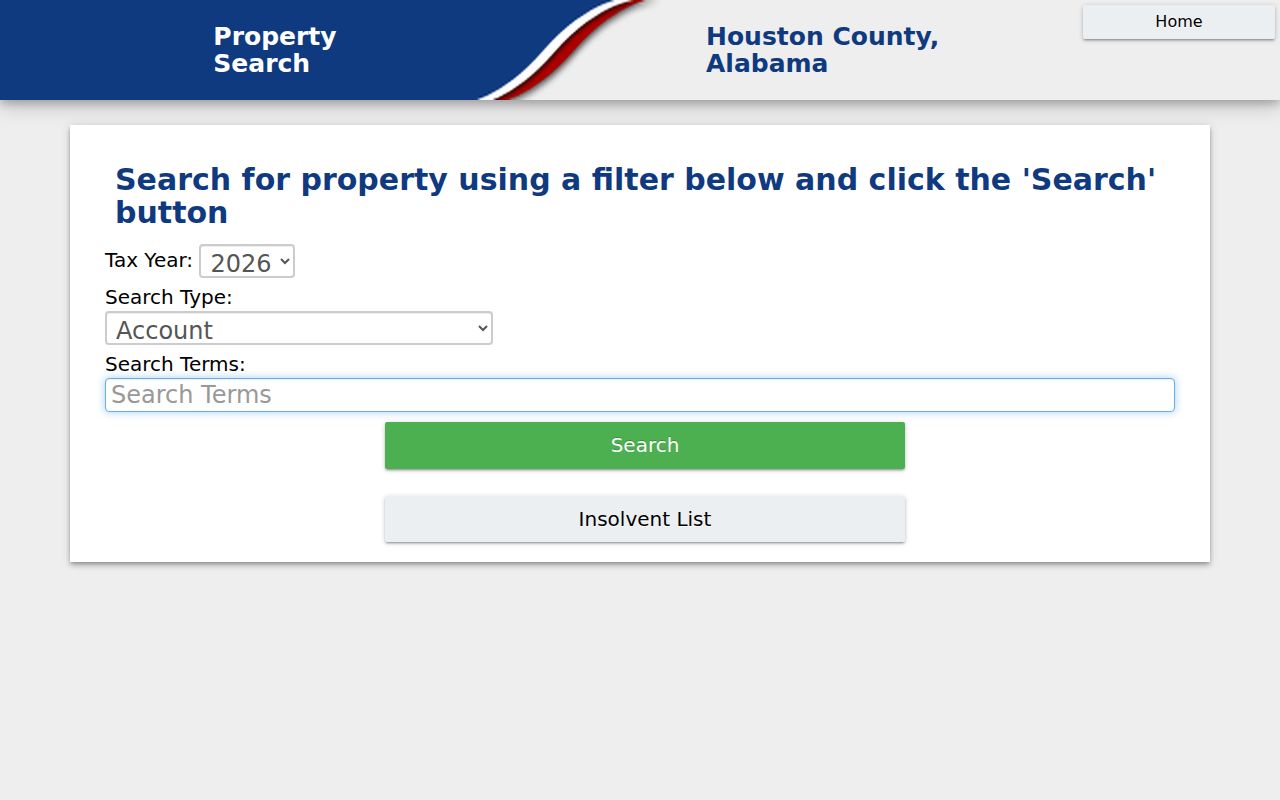
The tax-year and search-type controls sit on separate dials. The date behind the displayed owner matters as much as the name itself.
Compare Houston's Ownership Sources
No single Houston County screen handles every ownership question. Match the source to the question, and carry the same identifiers between systems.
| Official source | Ownership clue | Currency |
|---|---|---|
| Revenue property search | Assessment owner, mailing/situs, parcel or PPIN | Selected tax-year roll |
| Probate recording index | Grantor, grantee and recorded instrument | Recording sequence |
| KCS GIS viewer | Parcel location and spatial context | Current map, not title proof |
| Secretary of State | Business filing and registered-agent context | Entity record, not a land record |
- Owner of record
- The party named on the county assessment roll for the chosen tax year.
- Grantee
- The party receiving an interest in a recorded deed.
- Situs address
- The physical property address, distinct from the tax-mailing destination.
Separate Houston Mailing and Situs Addresses
The situs address locates the land itself. The mailing address is where Revenue sends the tax bill. It may point to another city, an attorney, a lender or a representative. It never proves occupancy. Dothan annexations and E911 changes can alter street numbers or names. The deed trail stays untouched. When an address search comes up empty, keep both old and current forms. Switch to PPIN. Rural records may carry community labels like Kinsey, Rehobeth, Grimes or Hodgesville. Postal and municipal geography often differ. The county's older ZIP crosswalk is a lead, not a parcel-boundary authority.
Trace a Recent Houston Sale Across Tax Years
Houston County's tax year runs October 1 through September 30. Revenue asks anyone acquiring real estate by deed, will, divorce decree or another vesting document to bring it in. That way, assessment can shift into the new name for the next tax year. A deed can therefore show up in Probate before the assessment owner changes. Always compare the roll year with the deed recording date. For a recent sale, the newest recorded deed is the stronger evidence. It shows the latest conveyance. Neither an index hit nor a portal result replaces a title examination. If a new owner's name returns nothing, search the prior roll year.
Decode Trust, Estate and LLC Owners
Never swap an entity on the roll for a presumed person. Search its exact name in Probate and compare the complete grantee language. Alabama Secretary of State business-entity records can add filing and registered-agent context, though an entity record does not prove the company still holds the parcel. Estate transfers may involve a will, letters, a court order or an executor's deed. Houston County Probate also lists a form for a deceased owner whose estate skips probate. Life estates and multiple grantees demand the full instrument rather than a compressed portal name.
Use Every Houston Records Access Channel
If online search stalls, call Revenue Assessing at 334-677-4753 or Mapping at 334-677-4755. Revenue sits on the fifth floor of the Administration Building, 462 N. Oates Street, Dothan, open Monday through Thursday, 7:00 a.m. to 5:30 p.m. Ask staff to search an older owner, parcel, PPIN or legal description. Probate recording help is available at 334-677-4723. Search and viewing are free. Downloaded pages cost $1 each. Purchases stay online for 30 days. No earliest online year is published. Older work may require deed books, office help or Alabama Archives county microfilm. A precisely described record can also be requested. The basis is Houston County Policy #50 and Alabama's Open Records Act.
Set Limits on a Houston Owner Lookup
The combined trail can identify the assessed owner. It can also flag an apparent recent conveyance and establish a recorded legal-description lead. It cannot guarantee clear title. It cannot settle a boundary, disclose every trust beneficiary or establish who lives at an address. GIS geometry is mapping context, not a survey. Revenue currently warns new owners about unsolicited letters offering deed-recording or homestead services. Verify such claims directly with Revenue or Probate. Houston County publishes no official property-fraud-alert enrollment page, so do not substitute another county's program.
Lawful use. Use owner records for property diligence, boundary questions, estate work and civic research; never use them to target, intimidate or harass anyone.
Document a Houston Owner Finding
A solid ownership finding deserves a paper trail. Record the address exactly as you typed it. Also record the tax year, the parcel, and the PPIN. Note the owner wording and the situs and mailing addresses. Note the deed book and page, and the date you consulted the portals. Did the search turn on a spelling variant or an old street number? Save that detail too. An audit trail this small lets another researcher retrace your route. No one has to treat a screenshot or a copied name as proof.
Conflicts between offices deserve honest reporting. When the deed and the tax roll disagree, describe both rather than picking a winner. Say that Revenue assessed the parcel to one party for a named tax year. Say that Probate recorded a later conveyance to a different grantee on a stated date. Then ask Revenue whether a vesting document has come in for the next assessment cycle. Estates, divorce decrees, life estates, trusts, and new entities all hide legal detail behind a short owner label.
Houston County's property and GIS portals give you a second checkpoint. Carry a map label back to the tax card by PPIN. Carry the tax-card legal description forward to Probate. If the polygon, the address, and the deed description refuse to align, stop. Do not name an owner conclusively yet. A parcel split, a replat, an address change, or a parent tract may explain the mismatch.
Older or missing material calls for a narrow request. Give the custodian the record type and the approximate date. Include the party, the parcel, and any known book and page. Alabama's Open Records Act permits inspection and copying, subject to exceptions and agency procedures. Houston County Policy #50 supplies the local framework for making the request. A precise ask beats requesting everything an office holds on an address.
Close the inquiry by reading the owner name in both directions. Search the name as grantee and again as grantor. A later grantor entry may show the displayed assessment owner already conveyed the tract. Review the legal description too, watching for exclusions, partial interests, and plat references. Ownership can affect a purchase or an estate decision. In that case, order the actual record and obtain professional title review. A free portal search is an efficient route to evidence. It is not a substitute for examining every instrument that may affect the land.