
Run a Houston Property Search Step by Step
Start from something familiar and end with an identifier that lasts. The Houston County Revenue property search takes an address, a name, a Parcel Number, a PPIN, a BPPIN, an Account, a Subdivision, or a Receipt#. Once the right tax parcel appears, copy its exact number and owner wording. Those details then carry you into the GIS viewer and the Probate records.
- Select Address and begin with the street number and street name; omit an overly specific suffix if the first search fails.
- Open the matching parcel and copy the parcel number or PPIN exactly, including leading zeros.
- Record the owner-of-record spelling, situs address, mailing address, tax year, and deed book/page reference shown.
- Use the identifier in the KCS GIS viewer to confirm spatial context, then use the owner and deed reference in Probate.
- Inspect the recorded instrument and request an office-certified copy when certified evidence is needed.
Recent transfers need a second pass. Run the property search under both the current and the prior tax year. Houston County's tax year runs October 1 through September 30, so a mid-year deed may not surface yet in the assessment roll. Revenue tells new owners to bring the vesting deed, will, divorce decree, or other transfer document to the office so the parcel is assessed in the next tax year.
Houston Revenue Portal Fields Worth Knowing
The public form offers tax-year choices from 2019 through 2026. No login or fee stands in the way. Note the default mode: Account is selected first, so an address lookup requires deliberately switching to Address before you type.
| Portal control | Input | Practical use |
|---|---|---|
| Tax Year | 2019–2026 displayed | Compare current and earlier assessment records. |
| Search Type | Name, Address, Parcel Number, PPIN, BPPIN, Account, Subdivision, Receipt# | Match the kind of identifier already in hand. |
| Search Terms | Text, up to 100 characters | Enter an owner, street fragment, or exact identifier. |
| Subdivision | Dropdown | Use after its choices populate in the live page. |
| Insolvent List | Separate button | Follow the delinquent-property route rather than an ordinary parcel query. |
The input mask on the account-style field reflects that field only. The county publishes no countywide parcel format behind it. So keep leading zeros intact. The official Houston property-search screen displays every available search control.
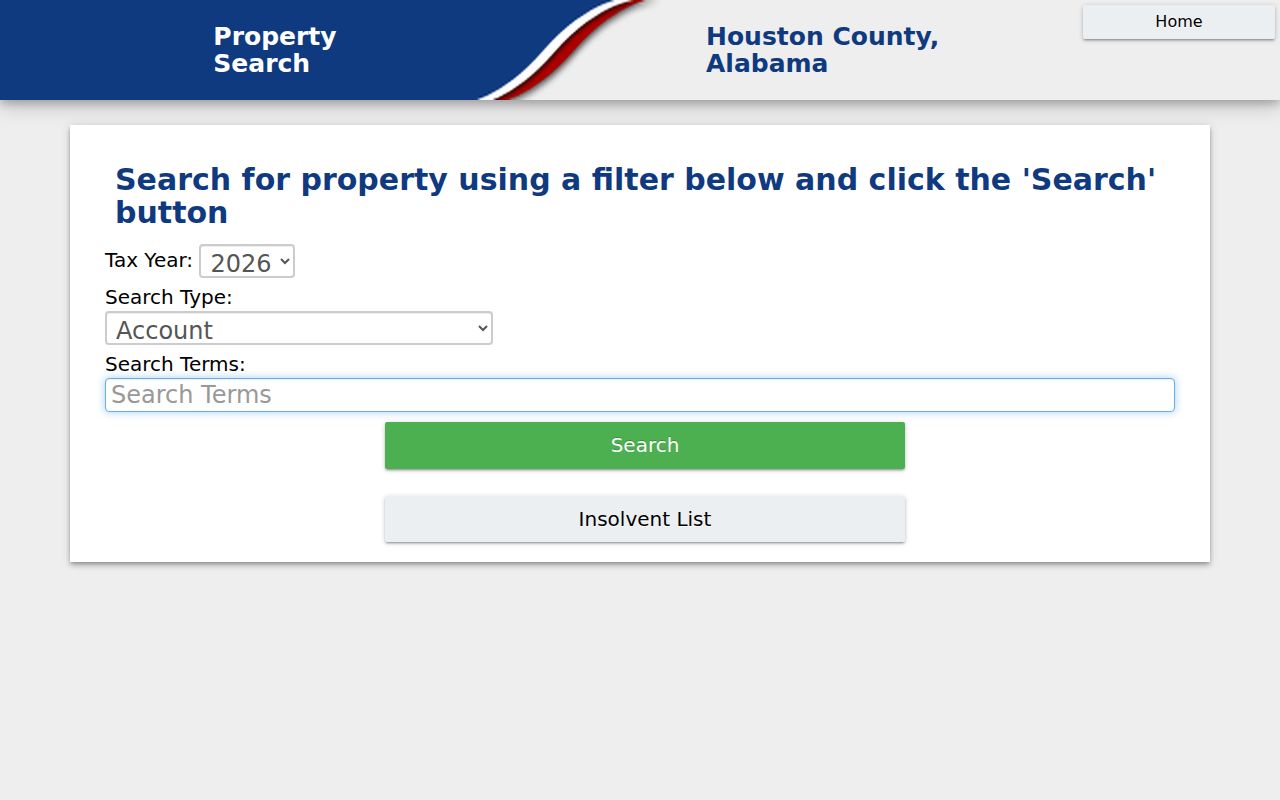
Tax year and search type are separate settings on the form. That distinction matters when a new deed has not yet been reflected under the latest assessment year, since picking the right combination is what surfaces the record.
Address, Owner, and PPIN Follow Different Paths
An address search is convenient but fragile. A street suffix or E911 renumbering can break it. So can annexation. A postal-city label that ignores municipal boundaries can break it too. Owner searches fail differently. Trusts, LLCs, estates, stray punctuation, and duplicate personal names produce false matches across several parcels. Once you get a first successful result, repeat the search. Running a Houston County property search by PPIN or Parcel Number is usually the cleanest path.
| Starting key | Best use | Useful fallback | Main caution |
|---|---|---|---|
| Street address | Known home or lot | Shorten to number plus street name; then try GIS | Situs is not the owner mailing address. |
| Owner name | Find several holdings | Try exact entity, trust, estate, or surname spelling | Same-name matches require parcel verification. |
| PPIN / parcel | Repeat an exact county match | Copy from the card or map without reformatting | It is not a deed instrument or book/page number. |
| Subdivision | Lot-and-block research | Check the recorded plat and name variants | Replats and vacations can change the trail. |
Why Houston Separates the Tax Card From the Map
The county property portal and the KCS GIS viewer are two different applications. That split is actually helpful. Revenue carries the assessment and mailing facts. GIS carries approximate parcel geometry, roads, and the context of neighboring parcels. Open one, copy the identifier, and then deliberately open the other. The county offers no official bulk parcel shapefile or tax-roll export, so the supported route is the interactive viewer or a focused request to Revenue Mapping at 334-677-4755.
Three identifiers carry you between the tax card and the map. Parcel number or PPIN: the county key for records. It reconnects a tax record to its mapped parcel. Situs address: the physical location of the land, distinct from the tax-mailing address. Owner of record: the party named on that tax year's assessment roll. That name can lag behind a newly recorded deed.
Note: A postal city or ZIP code can help locate an address, but it does not prove a parcel sits inside municipal limits.
What a Houston Property Record Can Show
A Houston County property card is reproduced in an ADEM project document. It shows what the county's fields actually contain. It is a dated sample. It is not a guarantee that today's live portal matches it line for line. Still, it works well as a checklist. Anything it lists is worth copying out of a fresh search result.
| Owner of Record | The person or entity assessed for the displayed year. |
|---|---|
| Situs / Mailing Address | The land’s physical address and the separate destination for tax correspondence. |
| Parcel Number and PPIN | The stable cross-reference for Revenue and GIS searches. |
| Land / Building / Appraised Total | Separate value components and their combined appraisal. |
| Legal Description | A brief lot/block, subdivision, or land-description clue that must be checked against the deed. |
| Deed Reference | Book/page or related reference that points into Probate records. |
| Acreage and Building Data | Tax-card measurements and improvement characteristics, not a boundary survey. |
The sample lists a district, acreage, subdivision label, owner, both addresses, land and building totals, appraised value, yearly tax, building details, and a deed reference. Its export date is October 2, 2023. Treat its values as illustrative rather than current.
Match the Houston Tax Card to the Probate Index
Carry the exact assessment-owner wording and deed reference to the Houston County Probate online-access instructions. The recorder's advice is simple. Enter names last name first, drop the punctuation, and use less information for broader results. Then tighten the list with an Index Filter. Searching and viewing are free. An account is optional for searching, and downloaded pages cost $1 each. Purchased documents stay available online for 30 days. Search the assessment owner as a grantee to find the acquisition deed. Then search that owner as a grantor to catch any later transfer. Never accept a same-name hit on its own. Compare the legal description, subdivision, lot and block, and recording reference before concluding it is the same land. The online index publishes no earliest year. For an older chain of title, call the Probate recording office at 334-677-4723 or visit 114 N. Oates Street in Dothan and ask for the relevant deed book.
Recover a Houston Search That Returns Nothing
Start by simplifying the input. Remove punctuation from an entity name, omit the street suffix, or search the prior tax year. The former owner is another useful lead. That name often appears on a deed or closing paper. Rural tracts need different keys. Use the community name, an old road spelling, the legal description, or the parent parcel rather than assuming the postal city matches the land's jurisdiction. Houston County formed in 1903 from Henry, Dale, and Geneva Counties. An older conveyance may sit with a parent county. That is a parent-county record, not a missing one. Sometimes GIS finds land that the Revenue search misses.
Record the visible identifier, then contact Mapping or Assessing through the Revenue office at 462 N. Oates Street, fifth floor, Dothan, open Monday through Thursday, 7:00 a.m. to 5:30 p.m., at Assessing 334-677-4753, Appraisal 334-677-4798, or Mapping 334-677-4755.
Choose the Best Houston Property Search Key
The right property search key depends on what you know. It also depends on what still needs verifying. An address works well for discovering a parcel. An owner name groups possible holdings or turns up transfer parties. Use the PPIN or parcel number when you need the exact match, and lean on the legal description when parcel splits, replats, or name collisions make the other keys ambiguous.
| Search Key | Best For | Where It Works | Watch Out |
|---|---|---|---|
| Address | A particular site | Revenue, GIS, Dothan permit follow-up | Old numbering, suffixes, annexation, postal labels |
| Owner name | Possible parcels or deed parties | Revenue and Probate | Trusts, LLCs, estates, punctuation, same names |
| Parcel / PPIN | An exact tax-map cross-reference | Revenue and GIS | Leading zeros and confusion with deed references |
Not a title search. A Houston property search can reveal recorded leads, but it does not guarantee ownership, clear title, a released lien, or a surveyed boundary. Review the instruments and use qualified title or legal help when the decision requires it.
Keep Houston’s Three Address Concepts Separate
Three address concepts matter here. In a Houston County property search, situs, mailing address, and legal description each answer a different question. Situs locates the property itself. A mailing address only directs Revenue correspondence. It might belong to an owner, lender, attorney, property manager, or a city far from the land. The legal description is the definition that counts. It fixes the land in a recorded instrument. The description uses lot and block, metes and bounds, section-township-range, or a combination.
ZIP codes add confusion. A 2011 ADPH ZIP crosswalk lists several codes for Dothan and overlaps involving rural communities such as Rehobeth and Grimes. Confirm any current label with the USPS ZIP Code Lookup. Boundary questions still call for county GIS and municipal records. Dothan annexation can change E911 addressing, zoning, services, and taxes without erasing the county deed history.
When Online Houston Property Records Are Not Enough
Online access is only one channel. Revenue staff can reconcile parcel identifiers, tax years, and owner updates by phone or at the Administration Building. Probate offers more than its web index. The office provides counter service, recording help by telephone, mail returns with a self-addressed stamped envelope, and certified copies. Some records never appear in a routine portal. For those, Houston County's Policy #50 request procedure implements the Alabama Open Records Act process adopted in 2024.
Historic addresses have other leads. The Dothan-Houston County Library local-history collection holds directories and Dothan Eagle microfilm, and Alabama Archives county microfilm and maps add more. Those sources suggest old names or addresses. Only a recorded deed supplies the conveyance trail.
Note: Ask the custodian for the exact record, year, name, and identifier, since focused requests are easier to locate and price.